
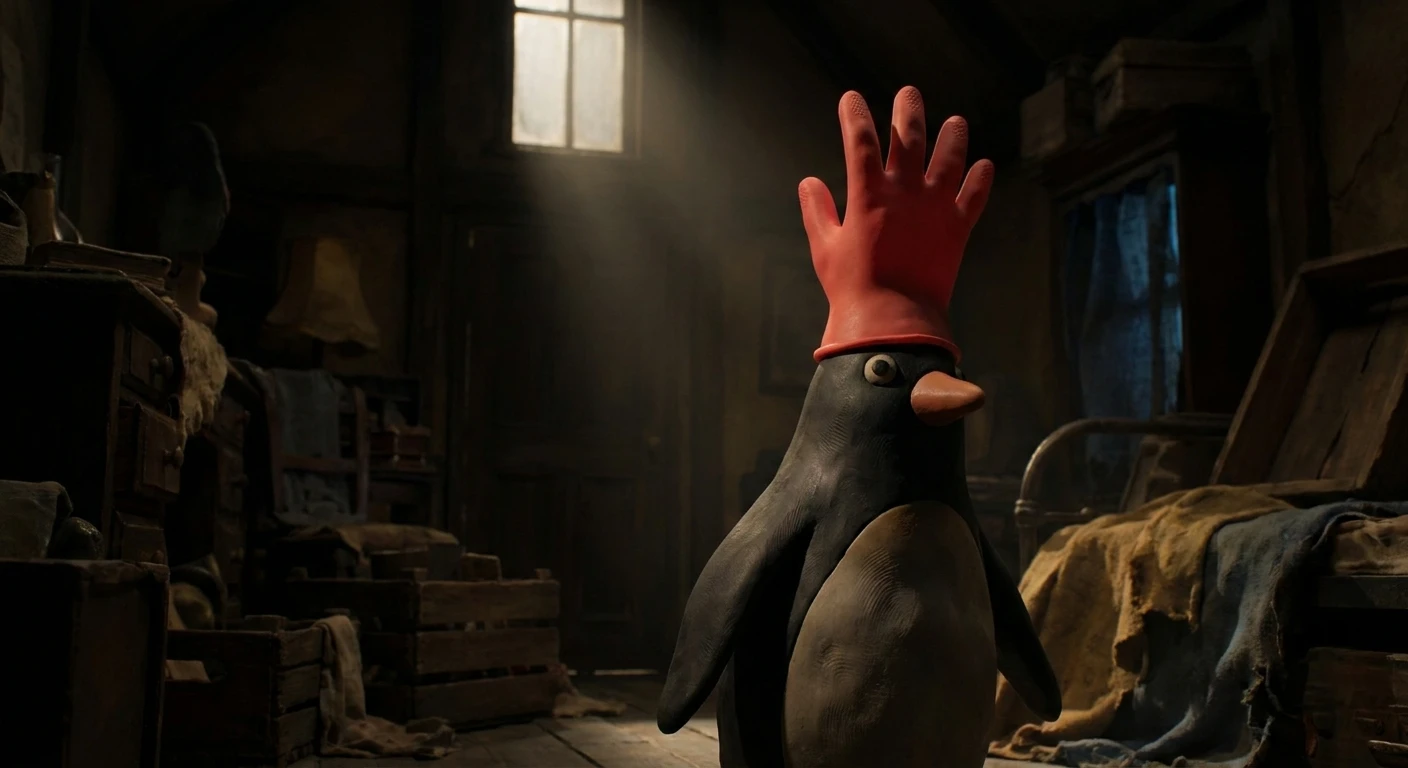
Feathers McGraw: The Ultimate Stop-Motion Mastermind
You know that sudden, creeping chill you get when someone stares at you with zero emotion? Feathers McGraw mastered that exact feeling decades ago. Look, when it comes to iconic animation antagonists, few hold a candle to the silent, calculating penguin who rented a spare room at 62 West Wallaby Street. First appearing in Nick Park’s 1993 masterpiece The Wrong Trousers, this seemingly innocent bird quickly proved that you do not need monologues, glowing laser eyes, or massive armies to become a legendary cinematic villain. All you need is a chilling blank stare, a red rubber glove, and absolute ruthlessness.
The brilliance of this character lies in his sheer simplicity. He is a masterclass in visual storytelling, relying entirely on pantomime and subtle movements to convey malevolence. You watch him operate, and you immediately understand his motives without a single line of dialogue. Over the years, the character has grown from a one-off jewel thief into a massive pop culture icon, representing the absolute pinnacle of stop-motion character design. We are going to break down exactly what makes this mute mastermind tick, how Aardman Animations brought him to life, and the enduring legacy he has carved into the history of animation.
Read also: Nintendo Switch 2 Sharp Screen: Display Specs Explained; Treatment Pool Room Safe Guide & Tips.
The Mechanics of a Perfect Heist: Why He Works So Well
Think about most movie villains. They usually fail because of their own ego, wasting precious time explaining their evil plans to the hero. Our favorite penguin does none of that. His methodology is grounded in cold, calculated action and pure stealth reconnaissance. He identifies a target, infiltrates the perimeter, neutralizes the immediate threats, and executes the mission with terrifying efficiency. The famous museum diamond heist using Wallace’s modified ex-NASA Techno-Trousers remains one of the most creatively staged sequences in cinema history.
To fully grasp his tactical genius, we have to look at his primary toolkit. The value proposition of this character design is that ordinary household items become instruments of high-stakes espionage.
| Espionage Tool | Primary Function | Iconic Execution Moment |
|---|---|---|
| The Red Rubber Glove | Complete identity concealment | Sliding it onto his head to instantly “become” a chicken. |
| The Techno-Trousers | Automated wall-walking and payload transport | Marching a sleeping Wallace vertically up a museum wall. |
| The Tape Measure | Precision depth calculation and target acquisition | Measuring the exact drop distance from the museum ceiling to the diamond display. |
There are several distinct reasons why he remains the gold standard for animated villains. His design forces the animators and the audience to focus on intent rather than dialogue.
- Total Absence of Monologuing: He never telegraphs his next move. The element of surprise is always fully maintained until the trap is sprung.
- Mastery of Psychological Warfare: Before the heist even begins, he systematically isolates Wallace from Gromit, manipulating their bond to remove the dog from the equation.
- Adaptability Under Pressure: During the legendary model train chase, when the track runs out, he calmly pulls a pistol, showing he is always prepared for the worst-case scenario.
Origins in The Wrong Trousers (1993)
To understand the phenomenon, we have to go back to the early nineties. Nick Park envisioned a lodger who would disrupt the comfortable dynamic between the cheese-loving inventor and his dog. The initial concepts toyed with various animals, but settling on a penguin provided a stark, monochromatic contrast to the warm, earthy tones of Wallace and Gromit’s home. The brilliance of The Wrong Trousers is how it frames the character as a mundane lodger first. He is just a quiet guy reading the paper. The gradual reveal of his criminal “Wanted” poster and his true intentions is a masterstroke in pacing, earning the film a well-deserved Academy Award.
Evolution into a Pop Culture Icon
After 1993, the character did not just disappear into the vault. He became a staple of British pop culture. You could spot him making cheeky background cameos in other Aardman productions, and he became a highly sought-after figure in merchandising. Video games, comic strips, and theme park rides frequently referenced the infamous chicken disguise. The sheer absurdity of a penguin successfully passing as a chicken simply by placing a red washing-up glove on his head became a legendary running joke, highlighting the delightful naivety of the humans in that universe.
The Modern State: A Mastermind’s Return
For decades, fans demanded his return, and they finally got their wish in the 2024 film Vengeance Most Fowl. Framing a retrospective on this recent release, it is clear that Aardman knew exactly what they were doing. Returning to a classic villain is always risky, but they played it perfectly. Instead of repeating the diamond heist, he orchestrated a complex revenge plot from behind bars, utilizing a smart gnome named Norbot. His 2024 return proved that his specific brand of silent, calculating malice is timeless, captivating an entirely new generation of viewers while satisfying long-time fans.
Technical Deep Dive: The Science of Silent Stop-Motion
Stop-Motion Armatures and Clay Rigging
You might just see a clay bird on screen, but beneath the surface, there is complex engineering. Aardman characters are built around highly articulated metal skeletons known as armatures. These armatures feature ball-and-socket joints that mimic human and animal biomechanics, allowing animators to pose the characters with microscopic precision. Because Feathers McGraw has a relatively solid, cylindrical body shape, his armature required specialized weight distribution to ensure he didn’t topple over when walking. The plasticine used for his “skin” is a specific blend formulated to resist melting under harsh studio lighting while remaining pliable enough to sculpt frame by frame.
Conveying Emotion Without Dialogue
Animating a character with no mouth and fixed, bead-like eyes is one of the hardest challenges in the medium. Animators have to rely entirely on body mechanics, timing, and lighting. A slow turn of the head, a fraction of a millimeter tilt, or simply having him stand perfectly still while chaos erupts around him communicates immense power.
- Frame Rate Mechanics: The animation is typically shot at 24 frames per second. Moving the character slightly for every single frame requires immense patience, often resulting in only a few seconds of usable footage per day.
- Micro-Gestures: Because he lacks facial expressions, animators use the shifting of his weight, the tapping of a flipper, or the angle of his beak to indicate thought processes.
- Cinematic Lighting Rigs: Lighting directors use harsh, contrasting shadows (chiaroscuro) to make his blank stare look deeply menacing, manipulating practical studio lights to catch the reflection in his black plasticine eyes.
- Wire Removal Technology: During the jumping or train-chase sequences, the character is supported by external metal rigs, which are meticulously painted out in post-production using digital compositing tools.
The 7-Step Blueprint for Cinematic Heist Excellence
Want to understand exactly how this villain pulled off the seemingly impossible? We can break down his methodology into a clear, actionable seven-step guide. This is the blueprint for creating the ultimate silent antagonist in any narrative.
Step 1: Secure Inconspicuous Lodging
The first move is insertion. You need a base of operations close to your target, or in this case, close to the technology you need to steal. Renting the spare room at Wallace’s house was a brilliant tactical maneuver. It placed him right next to the Techno-Trousers and provided a perfect cover as an innocent, paying tenant. No one suspects the quiet lodger.
Step 2: Eliminate the Local Security
A good strategist knows that dogs are the ultimate security system. Instead of fighting Gromit, the penguin used psychological warfare. By playing loud music, demanding extra attention, and altering the household routine, he made the dog feel so unwelcome that Gromit voluntarily packed his bags and left. Threat neutralized without a single scuffle.
Step 3: Establish the Ultimate Disguise
Infiltration requires disguise. The genius of the red rubber glove is its audacious simplicity. By modifying his silhouette, he manipulated the facial recognition logic of the local population (namely Wallace, who couldn’t tell the difference). It proves that sometimes the most effective camouflage is just hiding in plain sight with absolute confidence.
Step 4: Manipulate the Available Technology
Why break your own back when you can automate the process? Reprogramming the ex-NASA Techno-Trousers turned a harmless dog-walking invention into a remote-controlled mechanical infiltration suit. He mapped the controls, modified the walking algorithms, and turned an oblivious, sleeping Wallace into the perfect getaway driver and pack mule.
Step 5: Map Out the Target Architecture
Reconnaissance is crucial. The tape measure sequence is legendary for a reason. Before the heist, he systematically calculated the drop distances, the window entry points, and the laser grid spacing of the museum. You cannot just wing a diamond heist; you need exact spatial awareness to ensure the payload is extracted cleanly.
Step 6: Execute with Absolute Silence
The actual theft was executed with zero verbal communication. Noise creates variables, and variables create failure. By relying on remote control panels, helmet-mounted visuals, and a mechanical grabbing arm, the operation was executed with surgical precision. Silence is always a villain’s greatest asset.
Step 7: Plan the High-Speed Getaway
Even the best plans go sideways. When Gromit intervened, the resulting model train chase tested the penguin’s contingency planning. He used the environment, weaponized train cars, and maintained a cool head. While he was ultimately captured in a milk bottle, his rapid adaptation during the high-speed pursuit remains a textbook example of tactical retreat.
Myths & Reality: Clearing the Air
Even with decades of pop culture prominence, several misconceptions still surround this famous character. Let us set the record straight.
Myth: The character is actually a bizarre breed of chicken.
Reality: Despite the legendary disguise, he is unequivocally a penguin. The red rubber glove placed on his head simply acts as a makeshift comb to fool unsuspecting humans.
Myth: He speaks in deleted scenes from the original film.
Reality: The character has never uttered a single word. His complete silence was a core design principle from day one, relying entirely on pantomime and visual cues.
Myth: The 2024 film was his first appearance since 1993.
Reality: While Vengeance Most Fowl was his first major returning antagonist role, he has made numerous cameos in other Aardman films, shorts, and licensed video games over the decades.
Myth: Modern iterations use CGI for his complex movements.
Reality: Aardman remains fiercely dedicated to traditional stop-motion techniques. Even in recent projects, he is animated entirely by hand using physical clay models, with computers only used for rig removal and minor compositing.
FAQ & Final Thoughts
Who exactly is Feathers McGraw?
He is a silent, calculating jewel thief and antagonist from the Wallace and Gromit stop-motion animation franchise.
What kind of animal is he?
He is a penguin, though he frequently disguises himself as a chicken to evade capture.
Why does he wear a red rubber glove?
The glove acts as a makeshift comb on top of his head, serving as a hilariously effective disguise that fools almost everyone.
When did he first appear on screen?
He made his grand debut in the 1993 Oscar-winning short film The Wrong Trousers.
Did he return in recent Wallace and Gromit films?
Yes, he made a massive, highly anticipated return as the primary villain in the 2024 film Vengeance Most Fowl.
Who animates his character?
He is animated by the exceptionally talented stop-motion artists at Aardman Animations in the UK.
Why is he so scary to viewers?
His unblinking, emotionless stare and complete silence make him deeply unsettling, contrasting sharply with the usually cheerful, expressive world around him.
Ultimately, Feathers McGraw stands as a towering achievement in animation history. He proves that you do not need grand speeches or flashy superpowers to capture the imagination of millions. Through brilliant character design, masterful stop-motion execution, and a knack for high-stakes stealth, he remains the undisputed king of animated masterminds. If you have not witnessed his cold, calculating genius recently, do yourself a favor: grab some cheese, crack open The Wrong Trousers, and watch a true master at work.

Leave a Reply