
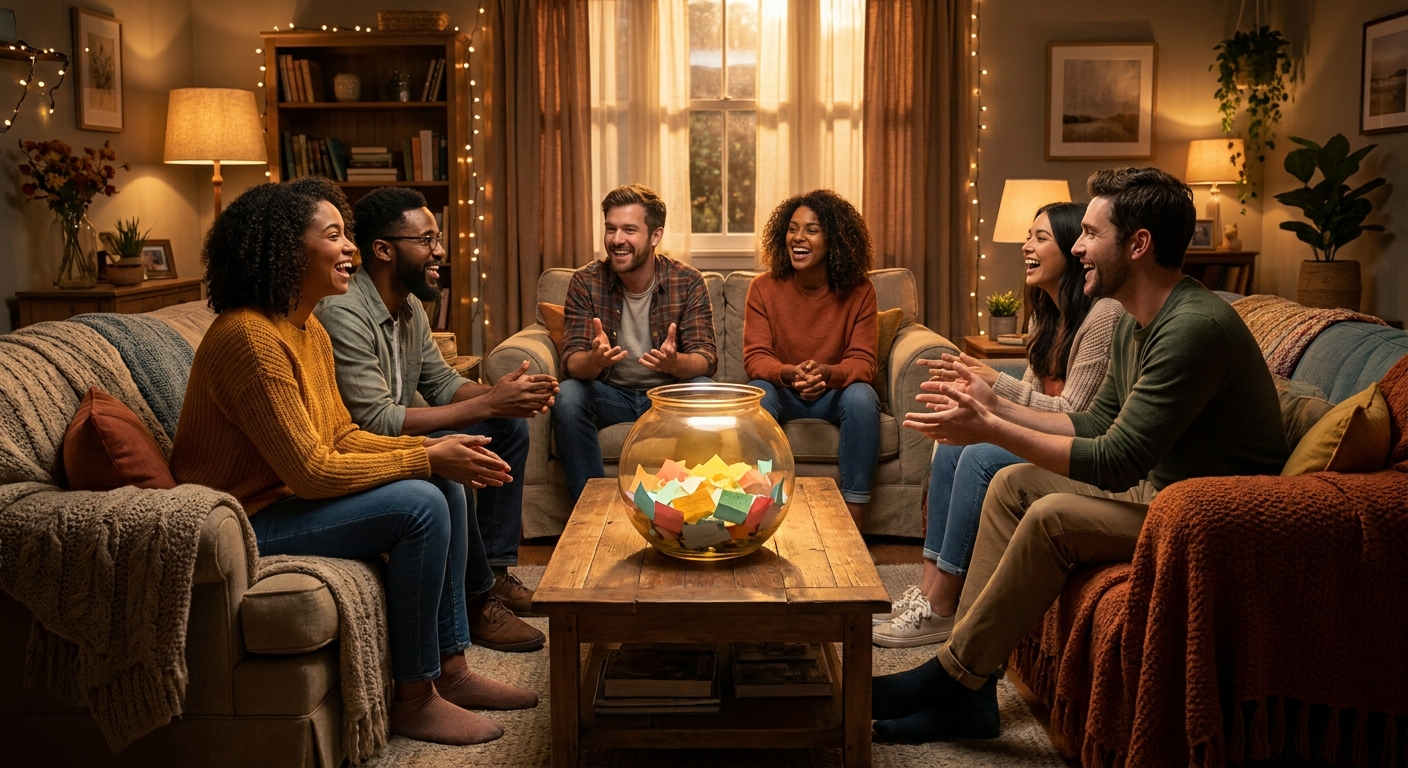
Why The Fishbowl Game Is the Ultimate Party Hack
Have you ever tried the fishbowl game when your Wi-Fi randomly drops and the night threatens to become utterly boring? Look, I am going to be entirely honest with you. The fishbowl game is literally the only thing that saved my sanity during the rolling blackouts in Kyiv a few winters back. I remember sitting in my cramped flat in Podil, candles flickering on the windowsill, while four of my friends just stared at their dead phone screens in complete silence. Someone grabbed a massive glass bowl from the kitchen, ripped up some old grocery receipts, and we just started playing. It completely changed the atmosphere in five minutes.
If you have never played it, you are missing out on the cheapest, most hilarious offline activity imaginable. It is basically a chaotic mashup of Taboo, Charades, and Password, smashed into three frantic rounds of inside jokes and aggressive yelling. You need absolutely zero electricity, zero expensive board game boxes, and zero prep time. All you need is your brain, some scrap paper, a pen, and friends who aren’t afraid to look incredibly ridiculous. By the time you finish reading this, you will know exactly how to dominate your next gathering. No fancy setups, just pure, unfiltered fun that guarantees genuine connection every single time.
The Core Mechanics and Unbeatable Benefits
Alright, let me break down exactly why you need to organize a session this weekend. The core value of this activity is how it forces people to actually look at each other and connect. When you are desperately trying to pantomime an octopus using only your face, you strip away all social awkwardness. I have seen this game work as the perfect icebreaker for complete strangers at a hostel, and I have also seen it put the ultimate test to the telepathic connection between best friends of ten years.
Setting it up takes roughly two minutes. Here is exactly what you do:
- Write the prompts: Hand everyone five slips of paper. Each person writes down a noun (person, place, or thing) on each slip, folds them, and tosses them into the main container.
- Divide the room: Split the group into two even teams. You will alternate turns, with one person from the active team trying to get their teammates to guess as many words as possible in one minute.
- Run the gauntlet: Play through three distinct rounds using the exact same set of words every time. Once the bowl is empty, tally the score, put all the papers back in, and start the next round.
The rules shift drastically as the night progresses. Here is how the phases break down:
| Round Number | The Rule Restriction | The Main Objective |
|---|---|---|
| Round 1: Taboo | Use any words except the target word | Establish the baseline definitions and get the words out |
| Round 2: Charades | Strictly no talking or sound effects allowed | Act out the exact same words using only physical motion |
| Round 3: Password | Speak exactly one single word as a clue | Trigger the team’s associative memory instantly |
By the time you hit the third round, everyone already knows the words circulating in the mix. That is the genius part. You aren’t guessing random concepts anymore; you are recalling what was already established. If someone wrote “Eiffel Tower” and it got guessed in round one, by round three, you just yell “Croissant” and your teammate instantly screams “Eiffel Tower!” It builds a bizarre, hilarious micro-culture among the players for that specific night.
Mysterious Origins of the Classic
No one really knows exactly who originally invented this specific combination of mechanics. Game historians track these types of parlor games back to the Victorian era. Back then, people obviously did not have smartphones to stare at, so they sat in stuffy parlors playing dictionary games and acting out historical figures to pass the time. It was a primary form of evening entertainment. The structure we use today likely organically evolved from these traditional parlor activities, passed down verbally from generation to generation.
Evolution Through the Eras
During the 1990s and early 2000s, commercial board game companies caught wind of these free public domain games. They started boxing up the mechanics, printing fancy cards, and selling them for forty bucks a pop. We got boxed versions of drawing games, acting games, and guessing games. But college students living in dorms with zero budget kept the original scrap-paper version alive. It became a staple of university parties because it required materials everyone already had on their desks.
The Modern State of Analog Play
Now that we are solidly navigating the year 2026, I am noticing a massive cultural pushback against digital-only entertainment. People are exhausted by screens. We spend all day on virtual meetings and scrolling feeds. Craving tactile, analog experiences is entirely natural right now. The resurgence of this specific paper-and-pen format proves that you cannot digitize the feeling of your friend frantically flailing their arms trying to act out a washing machine.
The Psychology Behind the Laughs
You might think you are just acting like a complete idiot for points, but there is actual rigorous cognitive science happening in the background. The progression of the rounds perfectly manipulates how the human brain processes and stores information. During the first phase, your brain relies heavily on semantic memory. You are describing facts, definitions, and context to trigger your team’s vocabulary. It is a highly verbal, logic-based process.
Cognitive Load and Memory Recall
As you progress, the cognitive load completely shifts. Round two moves away from the language centers of the brain and fires up the motor cortex. You are translating abstract concepts into kinesthetic movement. Then, round three is an exercise in pure episodic and associative memory. Your brain creates temporary neural pathways that link your friend’s weird hand gestures to a specific noun. Here are the physiological things happening to your group:
- Dopamine synchronization: When a team successfully guesses a hard clue at the last second, the synchronized cheering releases massive spikes of dopamine, bonding the group together.
- Heuristic shortcuts: By the final phase, your brain abandons logical thinking and relies on rapid heuristic shortcuts, basically guessing wildly based on minimal sensory input.
- Stress reduction: Uninhibited physical play significantly lowers cortisol levels, which is why everyone feels incredibly relaxed after a session ends.
Step 1: Curate the Guest List
The success of the evening heavily depends on who shows up. You want a sweet spot of 6 to 10 players. Fewer than six, and the teams are too small to generate good chaotic energy. More than ten, and people spend too much time waiting for their turn. Invite people who are willing to completely abandon their pride.
Step 2: The Perfect Noun Selection
Coach your guests on what words to write down. Force everyone to submit things that are actually possible to guess. Highly specific inside jokes that only two people know will tank the pacing. Encourage them to mix celebrities, everyday household objects, and famous locations. Banning abstract concepts like “freedom” or “sadness” is usually a good call.
Step 3: Setting the Vibe
Clear out the center of the room. You need a designated “stage” area where the active player stands so both teams have a clear line of sight. Make sure drinks and snacks are safely out of the splash zone, because people will inevitably jump around and knock things over.
Step 4: Rule Alignment
Before drawing the first slip, make the rules crystal clear. Decide on the penalty for skipping a word. House rules usually dictate that if you skip, you put the paper back and instantly lose a point. Clarify exactly what counts as “rhymes with” or “sounds like” in the first phase.
Step 5: Round One Strategy
During the verbal phase, speed is everything. Do not get stuck trying to perfectly describe a difficult word. Spit out synonyms rapidly. The strategy here is simply to expose the group to as many slips as possible so they enter the active memory pool for the later phases.
Step 6: Round Two Chaos
When the talking stops, the real performance begins. Encourage players to use the physical space. If the word is “spider,” lay on the floor and crawl. Bold, exaggerated movements always win over tiny, timid hand gestures. The weirder you act, the faster they guess.
Step 7: Round Three Telepathy
This is where legends are born. You only get one word. The ultimate strategy is to recall exactly how the word was guessed in round one. If “Batman” was described as “Gotham’s protector,” your one word should just be “Gotham.” Trust your team’s memory to bridge the gap.
Myths vs. Reality
Myth: You need to buy a specific, expensive box set or download a paid app to play this properly.
Reality: The raw, unbranded scrap paper version is infinitely superior. It costs absolutely nothing and allows for total customization of the prompts based on your specific friend group.
Myth: Loud, theatrical extroverts always dominate and win this activity.
Reality: While extroverts shine in the acting phase, quiet introverts usually dominate the final one-word phase. They are typically the ones who actually listen closely and memorize the entire word pool from the beginning.
Myth: The rules are strictly defined by internet authorities and cannot be changed.
Reality: House rules govern absolutely everything. Want to add a fourth round where you act out the word while hiding under a blanket? Do it. The structure is merely a canvas for your group’s dynamic.
What is the ideal player count?
Aim for 6 to 10 players. It creates perfectly sized teams of 3 to 5 people, keeping the rotation fast and engaging.
Can kids play this?
Absolutely. Just restrict the prompts to simple animals, foods, and household objects so they don’t struggle with complex pop culture references.
What if we run out of words?
If the final phase ends too quickly, simply hand out fresh paper, write new nouns, and start a completely new game from scratch.
Is there a fourth round?
Officially no, but many groups add a “Ghost” round where you have to act out the word using only your facial expressions, with zero body movement.
How long does a full match take?
Depending on the number of slips in the pool, a complete three-round match usually takes roughly 30 to 45 minutes.
Do I need a physical timer?
Yes. Use the stopwatch on someone’s phone. Strictly enforcing the 60-second limit creates the panicked urgency that makes the activity funny.
Can we use digital apps instead of paper?
You can, but the physical act of pulling crumpled paper out of a bowl adds a tactile element that digital screens completely ruin.
Final Thoughts
The fishbowl game remains an undefeated champion of living room entertainment precisely because it relies entirely on human connection rather than plastic pieces or screens. It tests your memory, destroys your dignity in the best way possible, and creates memories that you will joke about for years. Grab a bowl tonight, tear up some junk mail, and text your group chat right now to set up a match. Leave a comment below and let me know the absolute worst charades performance your friends have ever attempted!




Leave a Reply