
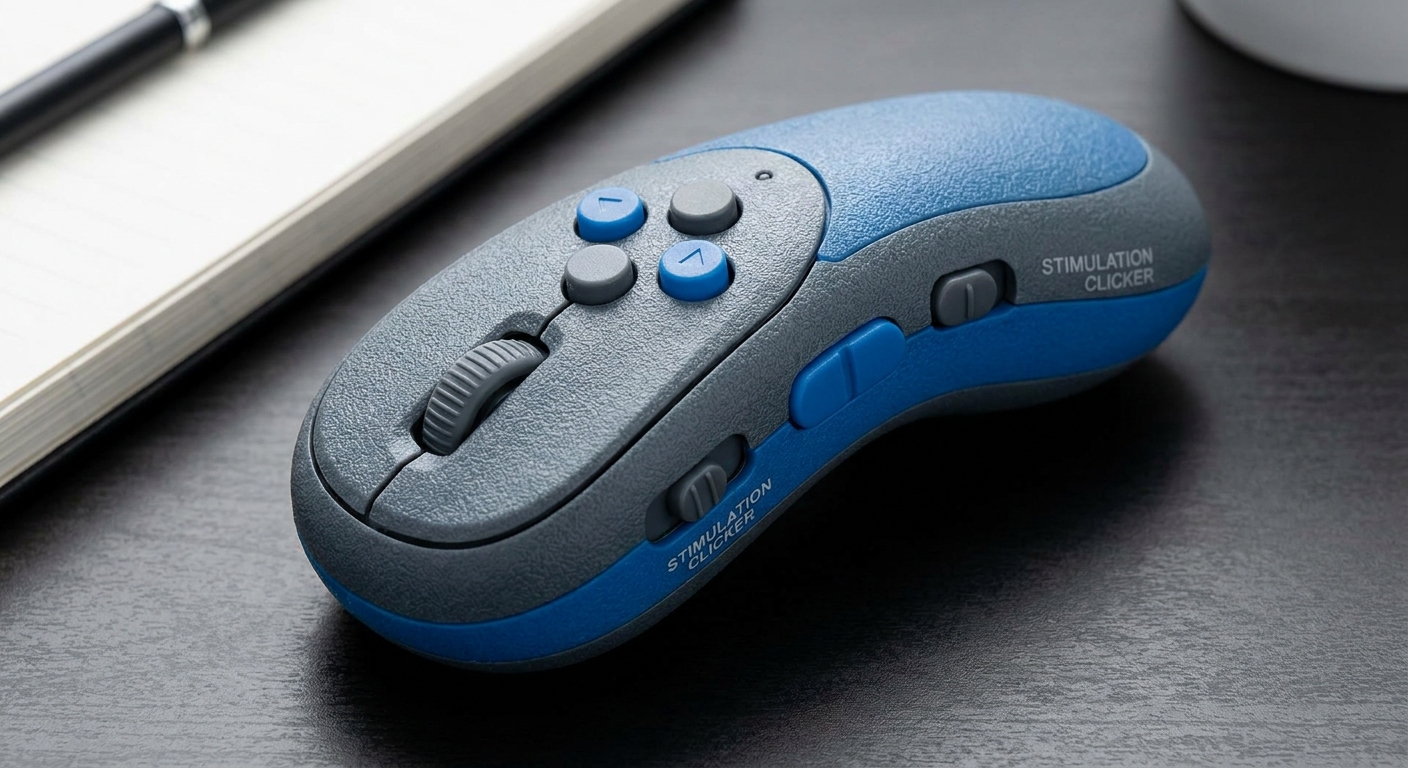
Why You Need a stimulation clicker Right Now
Listen, if you haven’t got your hands on a stimulation clicker yet, you are seriously missing out on a massive upgrade to your daily gaming routine and focus management. We all know that feeling of restless energy during long matchmaking queues or when you are stuck grinding out an endless resource loop. You need something tangible to bridge the gap between digital stagnation and active engagement. That is exactly where this brilliant little concept steps in. I vividly remember being back in Kyiv a couple of years ago during those brutal, endless blackout nights. My friends and I had to find creative ways to keep our minds sharp while the city was dark. We couldn’t run our heavy console setups or big PC rigs, so we relied on battery-powered mobile games and physical tactile tools. We literally built our own makeshift mechanical setups just to keep our fingers moving and our brains engaged. Sitting around a single battery-powered LED lamp, furiously hitting our improvised devices, we realized something incredibly profound about human psychology and pacing. Having that immediate, physical feedback loop fundamentally rewired our attention spans. It acted as an anchor for our wandering thoughts. The stimulation clicker became our lifeline for maintaining rhythm. And honestly, it is crazy to see how mainstream this concept has become for both hardcore tactical players and casual strategy fans alike.
Understanding the Core Mechanics and Daily Benefits
Let me break down exactly how this works and why it changes the way you approach your gaming economy and strategy. When you are deeply invested in an in-game economy, pacing is everything. You cannot just rush through upgrade trees without a rhythmic approach. A proper clicking setup provides continuous micro-feedback. It literally occupies the noisy, restless part of your brain so your higher-level strategic thinking can operate without distraction. Think of it as a background metronome for your tactical decisions. People often ask me what makes one setup better than another, and it really comes down to the quality of the tactile and auditory feedback.
| Feature Type | Psychological Benefit | Real-World Example |
|---|---|---|
| Tactile Mechanical Switches | Reduces physical anxiety and restless hand syndrome | Cherry MX Blue standalone desktop buttons |
| Auditory Rhythm Cues | Builds a consistent subconscious pacing rhythm | Digital incremental UI overlays with coin sound drops |
| Economy Scaling Sync | Regulates dopamine release during long grind sessions | Hardware mapped to secondary resource generation |
The value proposition here is absolutely huge. You are basically taking wasted nervous energy and funneling it into a structured, rhythmic action that keeps your brain in a state of flow. For example, look at the classic desktop fidget setups that utilize heavy, clicky mechanical switches. Every single press gives a satisfying bump and a sharp sound, acting as a mini-reward. Another great example is the digital overlay tools that reward mouse clicks with tiny, non-intrusive visual coin drops on the corner of your screen while you are doing something else entirely. If you want to integrate this properly, there are a few strict rules you should follow. Here is the best way to set up your environment:
- Pick your preferred switch or trigger type based on the acoustic profile that relaxes you the most. Do not go for loud switches if you share a room.
- Sync the physical action with your game’s internal economy ticks, so you build a subconscious timing habit for resource spawning.
- Map the action to a secondary, non-critical loop to ensure you are gaining actual value from the repetitive motion without messing up your main gameplay.
- Keep the device positioned ergonomically near your non-dominant hand so you do not strain your wrist during intense sessions.
The History and Origins of the Clicking Craze
Origins in Early Productivity Tools
To really appreciate what we have now, you have to look back at where this whole movement started. Long before we had perfectly engineered gaming peripherals, people were using mechanical tally counters. You know, those little metal clickers that bouncers use at club doors or inventory managers use in warehouses. Early gamers and hardcore strategy nerds realized that the sheer act of clicking those metal buttons provided a strange sense of relief. It gave a physical manifestation to abstract numbers. Eventually, this bled into early internet culture, where mindless repetition became a way to pass the time during incredibly slow dial-up connection loading screens. The physical click was reassuring; it meant something was happening, even if the screen was frozen.
Evolution Through Incremental Idle Games
Then came the absolute explosion of the idle gaming genre. Developers figured out that players loved seeing numbers go up simply by clicking a giant cookie or a monster on the screen. The entire gameplay loop was stripped down to the rawest form of input and reward. But clicking a flat mouse button for hours on end caused fatigue. Players started looking for better hardware, specifically searching for switches that felt rewarding. The software pushed the hardware to evolve. The concept of the stimulation clicker was basically born out of necessity because standard office mice were breaking under the immense pressure of millions of rapid-fire clicks. Gamers needed something robust, satisfying, and rhythmically tuned.
Modern State and Haptic Technology
Now that we are well into 2026, the technology has reached an insane level of sophistication. We are no longer just dealing with raw plastic buttons. Modern devices incorporate advanced haptic feedback engines similar to what you find in premium console controllers. They provide variable resistance, meaning the harder you press, the more pushback you get, simulating the feeling of breaking a barrier or mining a resource. Some of the highest-end models even sync via Bluetooth to your live service games, changing their vibration patterns based on the current season or the specific in-game economy event that is currently running. It is a brilliant fusion of physical sensation and digital reward.
The Neuroscience Behind Repetitive Gaming Actions
The Neuroscience of Repetition
I know it sounds wild to bring science into a discussion about clicking buttons, but the neuroscience behind this is genuinely fascinating. When you engage in a repetitive, low-effort physical motion, you are activating specific dopaminergic pathways in the brain. This continuous micro-action actually lowers cortisol levels, which is the hormone responsible for stress and anxiety. Have you ever noticed how you tend to bounce your leg or tap your pen when you are waiting for a match to start? Your brain is literally hunting for stimulation. By providing a dedicated, engineered tool for this, you satisfy that neurological craving. This allows your prefrontal cortex—the part of the brain responsible for complex strategy and critical thinking—to operate at maximum efficiency.
Dopamine Pacing Mechanics
The real secret sauce is something called dopamine pacing. In massive live service games or deep economy simulators, rewards are often delayed. You might have to wait hours to see the fruit of your labor. The clicker bridges that gap by offering instant, micro-doses of dopamine. It keeps you engaged without burning you out. Here are a few technical facts that explain why this works so flawlessly:
- Micro-actions reduce cognitive load by occupying the brain’s default mode network, preventing distracting daydreams.
- Rhythmic audio-tactile synchronization creates a phenomenon known as haptic resonance, which deeply reinforces habit loops.
- Incremental sensory rewards stabilize dopamine release, preventing the steep crashes you normally feel after losing a tough match.
- Tactile feedback creates a physical anchor, which significantly improves muscle memory retention for actual competitive gameplay.
The Ultimate 7-Day Integration Plan
If you want to actually see the benefits in your own daily routine, you cannot just randomly smash buttons and expect your focus to improve. You need a structured approach to integrate this habit. Here is my personal step-by-step roadmap for getting the most out of your setup.
Day 1 – Choosing Your Base Tool
Your first step is purely hardware selection. Do not just buy the first thing you see. Test out different mechanical switches if you can. Linear switches are smooth and quiet, while tactile or clicky switches offer that sharp feedback. Choose the one that naturally feels good to your fingers.
Day 2 – Finding the Right Rhythm
Spend this day just messing around while browsing the web or watching streams. Do not use it in a serious game yet. Just figure out your natural resting tap rate. Some people prefer a slow, methodical press every few seconds, while others like rapid bursts. Find your comfort zone.
Day 3 – Integrating Background Audio
Now, pair your physical clicking with some form of background audio. This could be a lo-fi hip hop track or ambient game sounds. Try to match your clicks to the beat of the music. This synchronizes your auditory processing with your motor skills.
Day 4 – Optimizing the Reward Loop
Time to bring it into your game. Start an idle game or an economy simulator on your second monitor. Map your physical clicks to a low-tier resource generator. Every time you physically press, you should see a tiny digital number go up. Watch how your brain reacts to this connection.
Day 5 – Pacing Your Sessions
You need to avoid burnout. Set a timer. Use the tool actively for 20 minutes while focusing on a main task, then put it down for 5 minutes. This creates a structured interval training session for your attention span.
Day 6 – Advanced Macro Setup
If your game allows it, and you are not breaking any terms of service, set up a gentle macro. Make your device handle repetitive UI management tasks, like clearing notifications or collecting daily rewards. Keep it fair and strictly for economy management, not competitive advantages.
Day 7 – Full Habit Integration
By now, grabbing the device should feel second nature. Whenever you sit down at your desk and feel that familiar wave of distraction hitting you, your hand should instinctively reach for it. You have successfully built a massive focus anchor.
Debunking Common Industry Myths
There is a lot of garbage information floating around forums regarding this topic. Let’s clear the air right now.
Myth: These tools are just cheap toys for hyperactive kids who cannot sit still.
Reality: Absolute nonsense. High-level professionals, competitive esports players, and serious economy strategists use these tools daily to maintain deep work focus and regulate their pacing during intense, high-stakes sessions.
Myth: Having an extra button to press will only distract you from your main gameplay.
Reality: It does the exact opposite. By giving your restless “monkey brain” a repetitive task to handle, your primary conscious attention is completely freed up to focus on complex tactical decisions and map awareness.
Myth: Any random button or old mouse works exactly the same.
Reality: Actuation force, acoustic profile, and switch travel distance drastically change the psychological effect. A mushy membrane key will not give you the same dopaminergic release as a perfectly tuned mechanical switch.
Frequently Asked Questions
What exactly is this device?
It is a dedicated physical or digital tool designed to provide continuous tactile and auditory feedback through simple, repetitive pressing motions.
Does it require special software?
Physical, standalone versions do not need any software at all. However, USB or digital overlay versions might require lightweight driver apps.
Can I use it for studying or working?
Absolutely yes. It is phenomenal for keeping your hands busy while reading long documents or sitting through boring remote meetings.
Are mechanical switches genuinely better?
Usually, yes. They offer a distinct, crisp tactile bump that membrane switches simply cannot replicate, which is crucial for the psychological reward loop.
Does it drain a lot of battery?
Purely physical models obviously use zero battery. The Bluetooth haptic models are incredibly efficient and usually last for months on a single charge.
Is it considered cheating in online games?
As long as you are just using it as a physical fidget tool, no. If you map it to execute complex macros in a competitive shooter, then yes, that violates rules.
Can it cause repetitive strain injury?
If you abuse it and click aggressively for ten hours straight without ergonomic support, yes. Always practice moderation and take stretching breaks.
Where do I even get one?
You can find them at major gaming peripheral retailers, custom keyboard shops online, or even build your own using spare switch testers.
Wrapping this all up, integrating a stimulation clicker into your daily grind is one of the smartest, lowest-effort improvements you can make to your overall gaming economy and strategy sessions. It regulates your focus, calms your nerves, and keeps your head in the game when things get slow. Stop letting your attention drift during those crucial resource-gathering phases. Grab your gear, set up your rhythm, and take complete control of your focus today!





Leave a Reply